Binarynights

Keyboard Shortcuts in Quick Open and Improved Layout Memory
One of ForkLift’s most powerful yet underrated features is the Quick Open window, a true time-saver that many users still don’t take full advantage of. With Quick Open, you can instantly access favorites and execute menu commands without having to dig through menus.
To use it, simply press the Esc key to open the Quick Open window, then start typing the name of the favorite or command you want to use. For example, typing “Downloads” will show options like Open Favorite > Downloads or Execute Command > Downloads, which corresponds to the Go > Downloads menu command. Use the arrow keys to navigate the list and press Enter to activate the selected item. It is especially helpful if you are unsure where a command is located or don’t know its shortcut.
Starting with version 4.3.3, Quick Open now displays the keyboard shortcuts next to each result, making it easier to learn and remember them as you work. For many commands, you can even press the shortcut directly while the Quick Open window is active, unless the shortcut also works inside a text field, in which case the text field action takes priority. Give Quick Open a try to make your workflow faster and more efficient, you might be surprised how much time it can save you.
Another improvements to your workflow:
ForkLift now remembers and reopens the content of the second pane when switching between One Pane and Two Pane Layouts. This means fewer disruptions and a smoother experience when adapting the interface to your needs. (This behavior was introduced in 4.3.1 but we forgot to mention it back then.)
The Activity Window now displays the number of items being synchronized. Whether you are syncing dozens or thousands of files, you will now have a clearer picture of what is happening in real time.
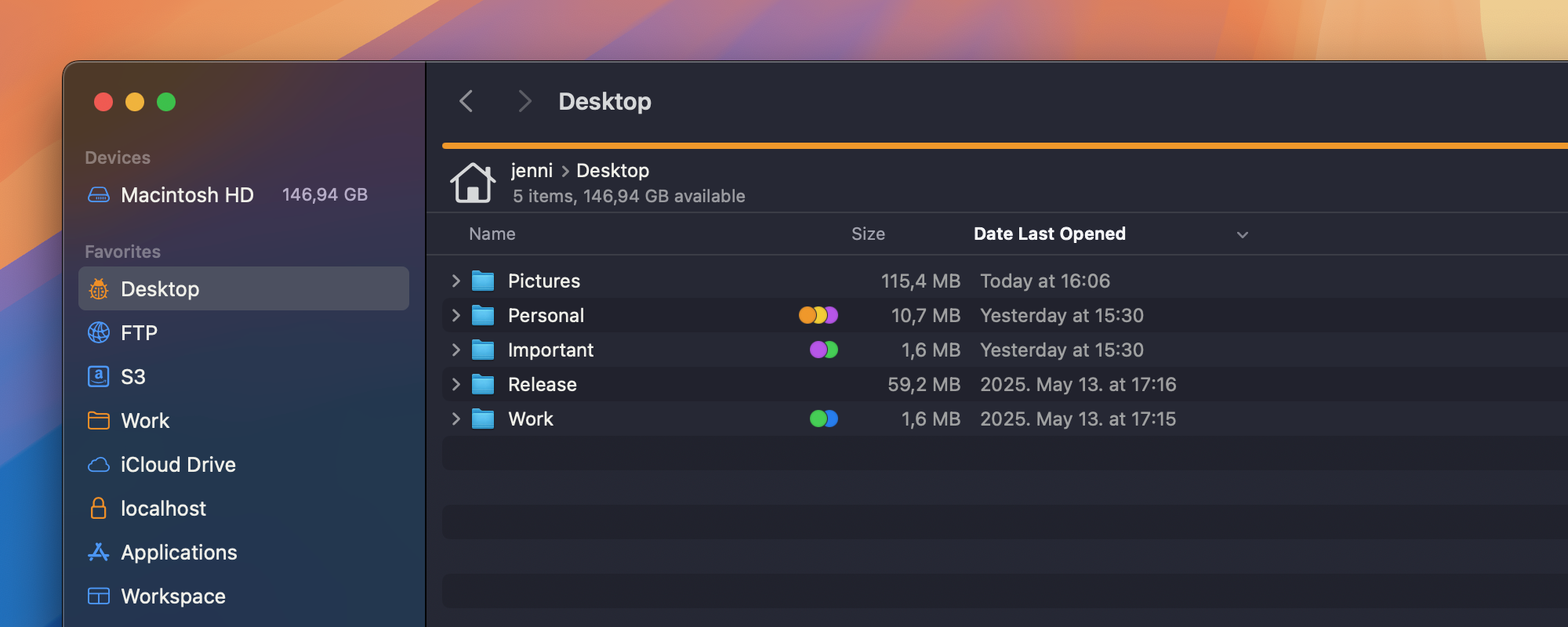
You can now add a “Date Last Opened” column to the List View, making it easier to identify recently used files at a glance.
Subtle Improvements
We have made some refinements to make your experience even more intuitive. ForkLift now ignores quotation marks in path entries in the “Go to Folder” window, the Esc key can close the “Copy to as” pop-up, and hidden files are easier to recognize in Icon View thanks to a lighter color tone.
Resolving Bugs
This release also includes a variety of fixes, from improving QuickLook behavior and Preview Pane reliability, to resolving some SFTP session issues and localization inconsistencies. We have also refined how ForkLift handles files with identical names but different letter casing during copy operations.
Full list of changes:
New
- Displays the keyboard shortcuts of the commands in the Quick Open window
- Displays the number of items in the Activity Window(s) during synchronization
- ForkLift now remembers and reopens the content of the second pane when switching between the One Pane and Two Pane Layouts (Introduced in version 4.3.1)
- Adds the option to add Date Last Opened column to the file view in List View
Improvement
- ForkLift ignores the single quotation marks of the paths in the Go to Folder window when they appear at both the beginning and at the end of a path
- It is possible to exit the “Copy to as” rename pop-up with the Esc key
- Hidden files are shown with a lighter color in Icon View, which makes them easier to differentiate
Fixes
- Removes the Assign Tag command from the list of commands in the Quick Open window when no item is selected
- Removes the tag favorites from the list of commands in the Quick Open window because they linked to the root folder
- Fixes an issue in the Preview Pane where the preview of the selected item got lost after the view inside the Preview Pane was changed to the Log or the Activities and then back to the Preview
- Fixes an issue that made it impossible to QuickLook an item after it has been renamed
- Fixes an issue that made it possible to accidentally delete the selected items in the background with the Command-Delete keyboard shortcut while the Quick Open or the Go to Folder window was activated
- Fixes in the French localization
- Fixes an issue where the session wasn’t correctly closed after disconnecting on SFTP connections
- Fixes an issue where it was possible to select the Show Original, Show Package Contents, and Show Archives Contents commands when multiple items were selected, which then didn’t run correctly
- Fixes an issue where if the content of a bundle was cloned, the content of the bundle was opened in an application instead of actually cloning the file view inside ForkLift
- Fixes an issue where it was possible to select the Calculate Folder Size command from the menu when only files were selected
- Fixes an issue where the file name did not change during local copy operations when a file was replaced by another file with the same name but with uppercase and lowercase letters used differently
- Numerous minor fixes and improvements